


- This event has passed.
Astronomy on Tap Corvallis: How We Search for Life on Ocean Worlds
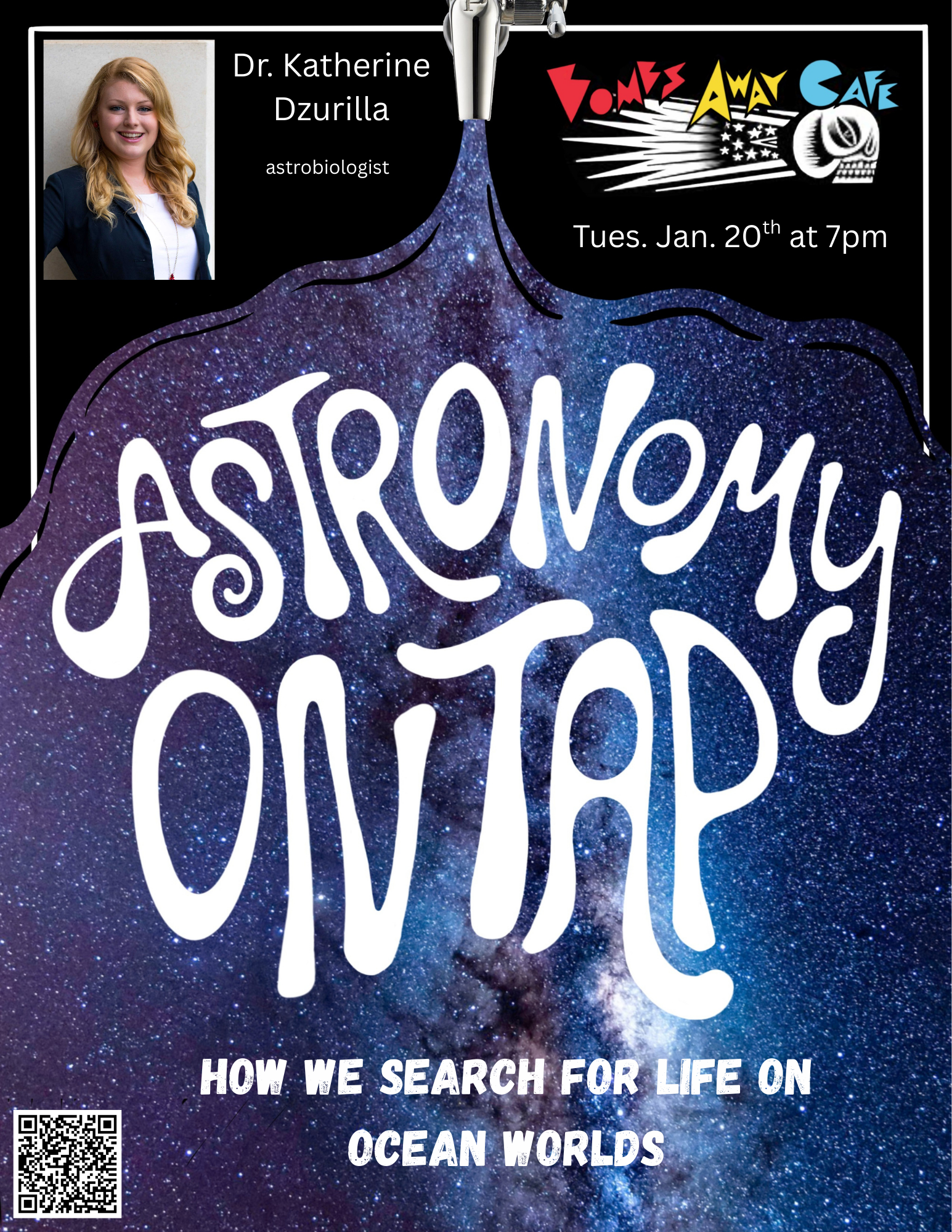
Join us on Tuesday January 20th at 7pm for a talk from astrobiologist Dr. Katherine Dzurilla! Her talk is titled:
How We Search for Life on Ocean Worlds
The search for life in the universe speaks to a fundamental part of being human. Moons within our solar system, such as Enceladus, Europa, and Titan, are thought to contain large, subsurface oceans under an icy crust. These ‘ocean worlds’ provide a unique case in the search for life outside of Earth. Subsurface oceans within each of these moons contain unique characteristics that could support prebiotic/biological systems. From an astrobiological perspective, understanding the chemistry, geology, and planetary systems within these ocean worlds can provide insight into the potential for ocean worlds to contain life. Future planned missions, such as the NASA/ESA mission Dragonfly, are tasked to journey to these ocean worlds to gather data on any potential life or prebiotic systems. This talk will cover the unique environments of ocean worlds, why they are important in the search for life, and how we detect and understand potential life signatures.
About Dr. Dzurilla
Dr. Katherine Dzurilla is an astrobiologist investigating the habitability of ocean worlds like Enceladus, Titan, and Europa. Her research focuses on mineral/organic reactions occurring in these environments and constraining any prebiotic or biological potential. Specifically, she investigates the abiotic production of macromolecules (e.g. depsipeptides, organophosphates) necessary for biological complexity to emerge from prebiotic systems. Her research incorporates an interdisciplinary approach, bringing in biochemical, geological, and planetary science perspectives. In addition to her research, Katherine has been involved in U.S. astrobiology strategy, serving as a Lloyd V. Berkner intern with the U.S. National Academies of Sciences Space Studies Board where she assisted with the 2023-2032 planetary science decadal. More recently Katherine served as the executive secretary for the 2025 NASA-Decadal Astrobiology Research and Exploration Strategy (DARES). Katherine attended Oklahoma State University and graduated with B.S. in biochemistry and physics, and completed her Ph.D. at the University of Arkansas. Her Ph.D. thesis focused on the solubility of tholins within Titan lakes, and their potential to form biologically relevant compounds. In her free time Katherine enjoys reading and spending time with her two cats, Mercury and Leia.