- This event has passed.
Astronomy on Tap Corvallis: Chicken Little Was Right: The Sky Is Falling
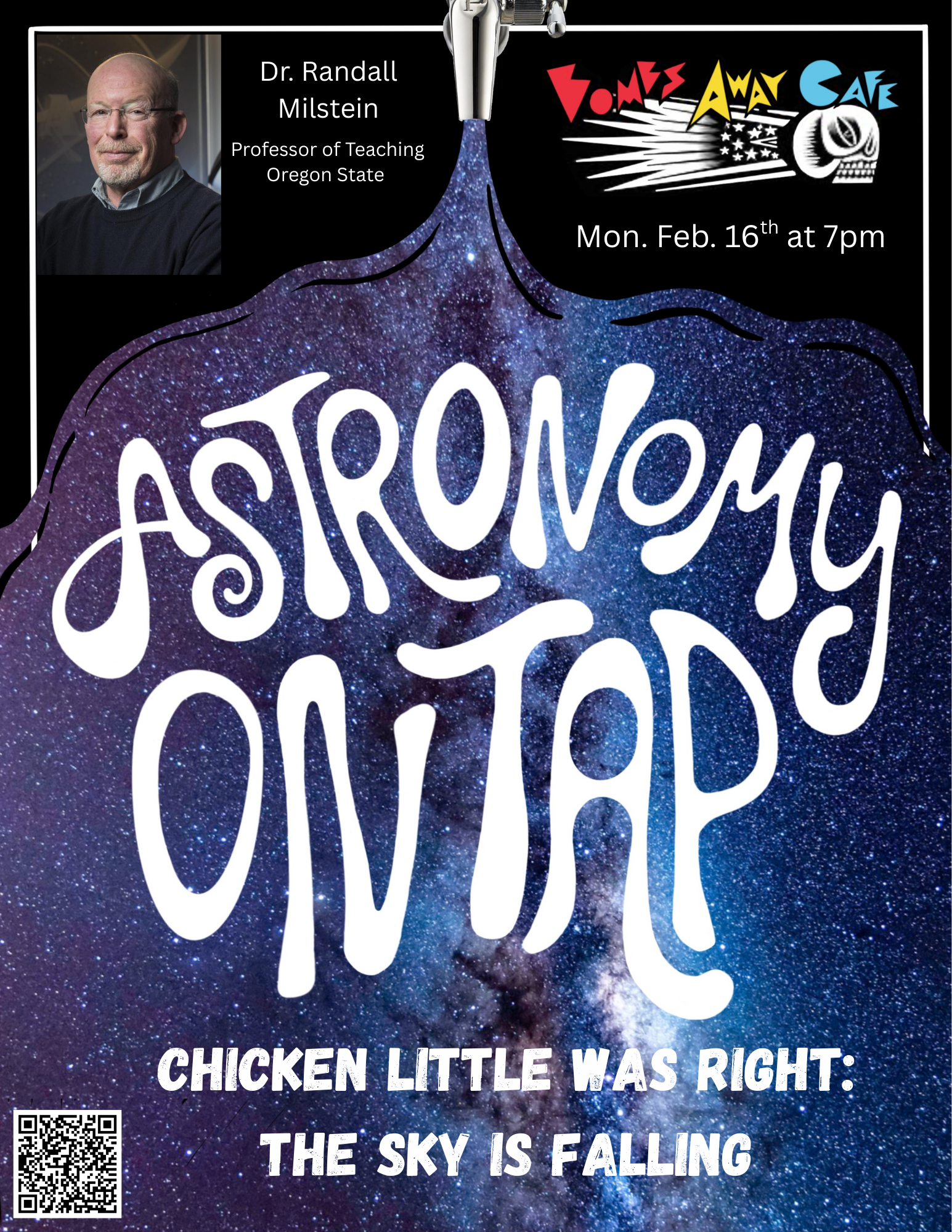
Join us on Monday February 16th at 7pm for a talk from Dr. Randall Milstein! His talk is titled:
Chicken Little Was Right: The Sky Is Falling
Impact craters are the most common and easily recognized landforms in the Universe. Impact is a primordial process in the origin of almost every object in space. Between 4.6 to 3.9 billion years ago, the frequency of impacts being significant object builders declined in our Solar System; instead, impacts became a modifying process and up to 50 tons/meter2 of asteroid material struck the inner planets’ surfaces. Earth is the most efficient recycling center in the Solar System and shows the fewest impact craters of all terrestrial planets and moons. On Earth, there are 194 verified impact craters on land and 24 on ocean floors. Despite erosion and plate tectonics, it is estimated there should be nearly 4000 identifiable impact craters on Earth. Why is it important we understand crater dynamics? We have identified over 36,400 near Earth asteroids, 900 of those over 1km+ in diameter. The K/T extinction event that saw the demise of the dinosaurs was initiated by a 10km asteroid strike on Earth. There is a 1 in 2000 chance Earth will be struck by a 1km+ sized asteroid in the next 50 years. Such an impact would have an initial human death toll of over 1 billion and secondary deaths well beyond that number from environmental collapse. We currently have no timely or practical planetary defense against an incoming asteroid.
About Dr. Milstein
Dr. Randall L. Milstein is a Professor of Teaching in the Oregon State University Physics Department, and the OSU Honors College. He has been teaching at OSU since 1990. Since 2016 Dr. Milstein has been an Astronomer-in-Residence to the Oregon NASA Space Grant Consortium (OSGC). He is also a NASA/Jet Propulsion Laboratory Solar System Ambassador. Dr. Milstein is the recipient of the OSU College of Science Distinguished Service Award for his outreach engagements. Dr. Milstein’s research interests include impact-cratering dynamics, astrogeology, archaeo-astronomy, and the interweaving of science and the arts.