- This event has passed.
Astronomy on Tap Corvallis: Gravity Talks, LISA Listens
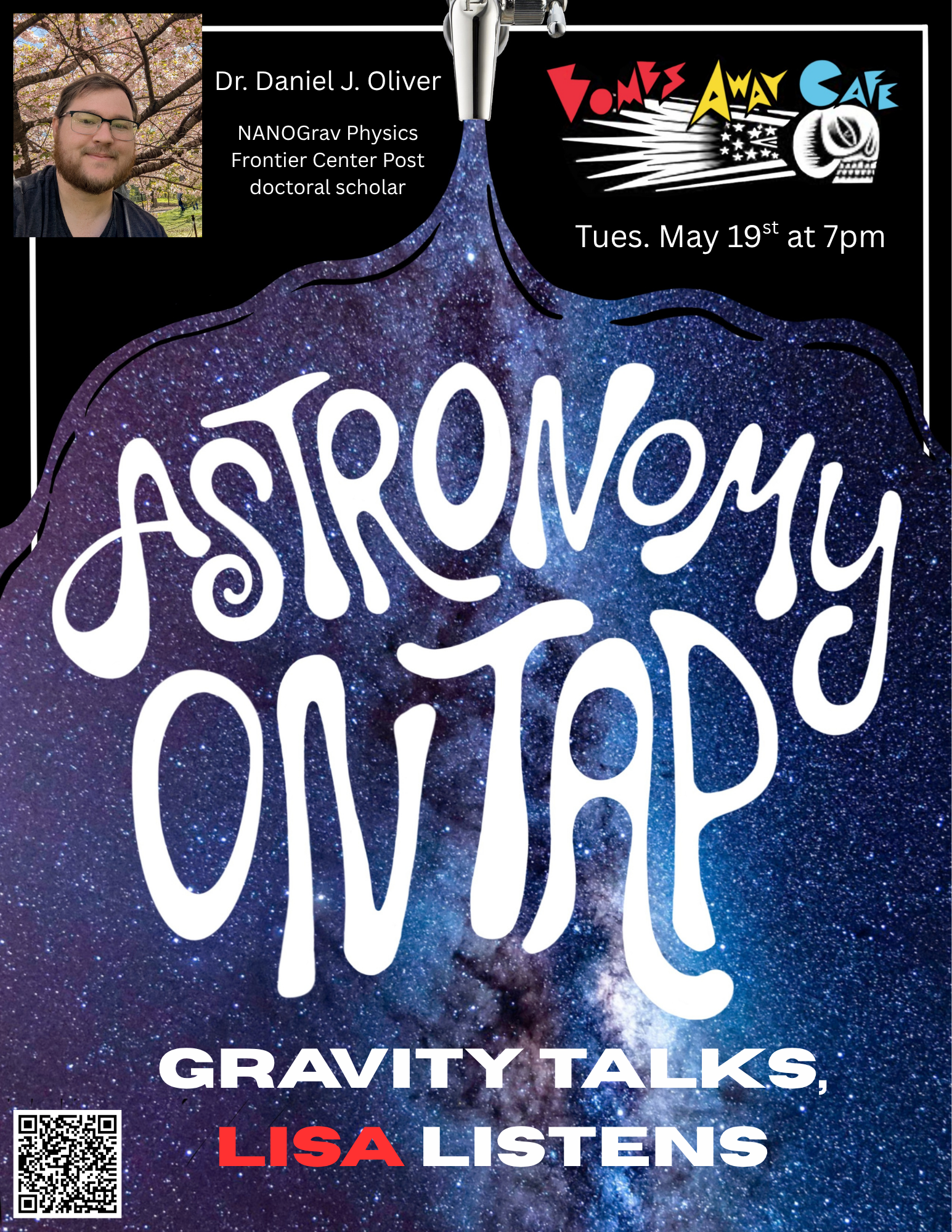
Join us on Tuesday May 19th at 7pm for a talk from Dr. Daniel Oliver! His talk is titled:
Gravity Talks, LISA Listens
The universe is alive with gravitational waves, ripples in spacetime created when massive objects like black holes, neutron stats, and white dwarfs orbit one another. While the first direct detection of gravitational waves came in 2015 from LIGO’s observation of merging stellar mass black holes. A complementary picture is emerging in pulsar timing arrays such as NANOGrav, which in 2023 provided evidence for a very low- frequency gravitational wave background. But between these discoveries lies an untapped frequency range,the millihertz band, where the Laser Interferometer Space Antenna (LISA) will listen. In this talk, we’ll explore what LISA is, how it works using time-delay interferometry, and the rich variety of sources it will detect, from extreme mass ratio inspirals and merging massive black holes to galactic white dwarf binaries and the confusion noise created by millions of overlapping signals. We’ll see what realistic LISA data looks like across time, frequency, and time-frequency domains, and discover how scientists will identify and characterize individual sources hidden within this crowded gravitational wave sky. Finally, we’ll discuss the current progress toward LISA’s launch and the exciting data analysis challenges ahead.
About Dr. Oliver
Daniel Oliver is a Postdoctoral Research Fellow with the NANOGrav Physics Frontiers Center at Oregon State University, working with Dr. Jeffrey Hazboun and Dr. Xavier Siemens. He studies gravitational waves,ripples in spacetime generated from massive objects orbiting each other for both pulsar timing arrays and the Laser Interferometer Space Antenna (LISA). At OSU, he focuses on pulsar timing and noise characterization,including chromatic noise models and analytically modeling the sensitivity to anisotropic gravitational wave backgrounds.
Daniel earned his Ph.D. in Space and Planetary Sciences from the University of Arkansas under Dr. Daniel Kennefick, where his dissertation introduced “gravitational wave peeps”, very highly eccentric extreme mass ratio inspirals (EMRIs) that produce recurring bursts of gravitational radiation. His work developed accurate waveform models for these sources and characterized how a background of such unresolvable signals would appear in LISA data..